
Paying in China as a Foreigner: Alipay, WeChat Pay, Cards, and Cash Explained
Worried your cards won't work in China? Here is how to set up Alipay and WeChat Pay with a foreign bank card before you fly, avoid the 3% transaction fee, and keep a reliable cash and card backup.
Few parts of planning a trip to China cause more anxiety than figuring out how you are actually going to pay for your first taxi or bowl of noodles. Spend ten minutes on travel forums and you will read stories of tourists locked out of apps at the airport, cards declined at hotel counters, and street vendors staring blankly at a crisp 100-yuan note.
The reality on the ground is much less intimidating once you understand how the system fits together. Foreign travelers no longer need a Chinese bank account or a local phone number to use China's two dominant mobile wallets, Alipay and WeChat Pay, and both now link directly to overseas Visa, Mastercard, JCB, Discover, Diners Club, and UnionPay cards. With thirty minutes of setup before you board your flight, plus a modest stack of physical cash for emergencies, you can pay as smoothly as a local while keeping transaction fees out of your China trip budget.
Pre-Flight Payment Setup Checklist
Before flying to China, travelers should install and verify both Alipay and WeChat on their home mobile network, link at least two foreign bank cards to each app, enable international transactions with their card issuers, and prepare a roaming data plan or travel eSIM so SMS security codes arrive reliably.
Waiting until you land in Beijing or Shanghai to configure payment apps is the single most common reason travelers end up stranded at the airport. Both apps send SMS verification codes to your home phone number during registration and initial card binding, and receiving those texts over airport Wi-Fi without active roaming rarely works.
Download both Alipay and WeChat at home: Install the standard versions from the Apple App Store or Google Play Store and register with your regular international mobile number (select your own country code, not the default +86).
Complete passport identity verification immediately: Open the account settings in both apps, upload a clear photo of your passport bio page, and complete the short facial-recognition scan so your account is cleared for full tourist spending limits.
Link two different cards to each wallet: Add a primary Visa or Mastercard and a backup card from a different bank to both Alipay and WeChat Pay in case one issuer flags an overseas charge.
Check your bank's fraud and 3D Secure settings: Make sure the mobile number registered with your bank can receive SMS one-time passcodes while you are abroad, or switch your bank's authentication method to in-app push notifications before departure.
Activate transit QR codes for your arrival city: In Alipay, tap the Transport tab at the top of the home screen and pre-activate the metro and bus cards for the first city on your China itinerary so you can tap straight through the station turnstiles when you land.
Sort out mobile data before takeoff: Mobile payments require an active internet connection for almost every purchase; arrange a travel eSIM or international roaming package so your phone is online the moment the plane touches down.
How Foreign Cards Link to Alipay and WeChat Pay (and Why Verification Fails)
Foreigners link international Visa, Mastercard, JCB, UnionPay, Discover, or Diners Club cards to Alipay and WeChat Pay by registering with an overseas phone number and uploading a passport scan, while most verification failures happen because of mismatched middle names, glare on passport photos, or unverified spending caps.
You do not load a prepaid balance into Alipay or WeChat Pay when using a foreign card. Instead, the Chinese app acts as a pass-through wallet: when you scan a merchant's QR code or a cashier scans yours, the app charges your linked overseas card in real time. Under People's Bank of China guidelines for overseas visitors, completing real-name passport verification raises your mobile payment ceiling up to roughly USD 5,000 per single transaction and USD 50,000 per year, whereas leaving your account unverified restricts you to much smaller trial limits (around USD 500 lifetime on Alipay or CNY 6,500 per transaction on WeChat Pay) and can trigger sudden freezes mid-trip.
Setting Up Alipay vs. WeChat Pay
Alipay is generally the more forgiving primary wallet for international tourists because its English interface is built around travel services, whereas WeChat Pay lives inside a sprawling messaging app and is slightly stricter about account security.
Alipay path: Tap Account in the bottom corner, select Bank Cards to add your card, then go to Settings > Account and Security > Identity Information to scan your passport and complete the selfie check.
WeChat Pay path: Tap Me > Pay and Services > Wallet > Bank Cards to add a card and trigger the passport upload prompt. If Pay and Services does not appear right away on a brand-new WeChat account, go to Me > Settings > General > Tools > Weixin Pay and enable it manually.
What works and what does not: Linked foreign cards work at almost any registered business, restaurant, taxi, or ticket machine in China, as well as inside mini-programs like DiDi (ride-hailing). However, foreign cards cannot be used for peer-to-peer transfers, sending red packets (hongbao), or topping up an in-app wallet balance.
Why Verification or Card Linking Fails and How to Fix It
When a foreign card refuses to bind or an identity check bounces back, the problem is almost always a formatting mismatch, not a ban on your card.
Middle name mismatches: Enter your name in the identity verification screen in the exact order it appears on the machine-readable zone at the bottom of your passport:
LASTNAME FIRSTNAME MIDDLENAME, with no punctuation.Passport glare and cropping: Hologram reflections on laminated passport pages cause automated checks to fail; shoot the page in diffuse indoor light without flash and keep all four corners visible.
Prepaid and virtual card blocks: Standard debit and credit cards from major banks, as well as multi-currency debit cards like Wise and Revolut, usually link cleanly. Single-use virtual card numbers and anonymous prepaid gift cards are frequently rejected.
WeChat security blocks on new accounts: Unlike years past, you do not normally need an existing Chinese user to vouch for you if you bind a foreign bank card during registration, but registering over a VPN or virtual VoIP phone number often trips WeChat's automated anti-fraud lock. Always register over your real mobile carrier connection with VPNs turned off.
Feature or Limit | Alipay (Foreign Card) | WeChat Pay (Foreign Card) |
|---|---|---|
Supported Card Networks | Visa, Mastercard, JCB, UnionPay, Diners Club, Discover (Amex varies by issuer) | Visa, Mastercard, JCB, UnionPay, Diners Club, Discover, Amex |
Unverified Spending Cap | Up to ~USD 500 cumulative before passport check required | Up to CNY 6,500 per transaction (varies by account risk check) |
Passport-Verified Cap | Up to USD 5,000 per transaction / USD 50,000 per year | Up to USD 5,000 per transaction / USD 50,000 per year (platform daily caps may apply) |
Peer-to-Peer Transfers | Not supported with foreign cards | Not supported with foreign cards |
Transaction Fees, the 200 RMB Rule, and Exchange Rates
Both Alipay and WeChat Pay waive their service fee on single transactions of 200 RMB (about USD 28) or less, but automatically add a 3% international card fee to the entire purchase amount whenever a single payment exceeds 200 RMB, on top of any foreign transaction fee charged by your home bank.
That 200 RMB threshold is one of the most important numbers to know for day-to-day spending in China. For almost everything you buy on the street (metro rides, coffees, museum entries, DiDi rides, and casual meals), you will pay 0% in platform fees. Once a single bill crosses 200.01 RMB, however, the 3% surcharge applies to the entire amount. A 250 RMB dinner costs an extra 7.50 RMB in platform fees; a 2,000 RMB hotel bill adds 60 RMB.
Single Payment Amount | Alipay / WeChat Fee | What Your Card Issuer Adds | Practical Ways to Avoid the 3% Fee |
|---|---|---|---|
200 RMB or less | 0% (Free) | 0% to 3% depending on your bank's foreign transaction policy | Use a zero-foreign-transaction-fee credit card or multi-currency debit card |
Over 200 RMB | 3% on the full transaction amount | 0% to 3% depending on your bank's foreign transaction policy | Ask merchants to split bills into chunks under 200 RMB, pay hotels directly by physical card, or book trains and hotels online in advance |
Keep in mind that platform fee rules and promotional waivers change periodically. For example, WeChat Pay has run seasonal promotions waiving the 3% fee on daily spending up to 1,000 RMB for 60 days for newly linked international cards, and certain overseas UnionPay cards are exempt from the surcharge. Always glance at the payment confirmation screen before entering your PIN: both apps explicitly itemize the 3% international card fee if it applies. If you capture a merchant fault or cancel an order and receive a full refund, the 3% fee is refunded along with the purchase.
When you pay through Alipay or WeChat Pay, currency conversion from CNY to your home currency is handled at the card network's exchange rate (Visa or Mastercard) plus whatever markup your issuing bank charges. To keep exchange losses from quietly inflating your trip costs, link a travel credit card with no foreign transaction fees or a multi-currency card like Wise that lets you hold and convert CNY at near-mid-market rates. Because small surcharges and seasonal price swings can add up over a two-week route, you can use Chinerary's per-city, per-category budget check to see whether payment fees or local prices are pushing a city over budget. It compares your planned food, activities, local transport, and accommodation spending against web-sourced typical ranges for each stop and is free for every account until January 1, 2028.
How Much Cash to Carry and Where Physical Cards Actually Work
Travelers should carry 500 to 1,000 RMB (roughly USD 70 to USD 140) in small physical banknotes as an emergency reserve, because while Chinese law forbids merchants from refusing cash, physical foreign credit cards are rarely accepted outside international hotel chains, upscale restaurants, and major airports.
You do not need to bring thousands of yuan in cash, and you can comfortably go an entire two-week trip without touching a banknote if your phone stays charged. Still, having a physical backup cushion removes all stress when an app glitches or your phone battery dies in winter weather, whether you are navigating big-city subways or heading into mountain towns like Huangshan or Fenghuang.
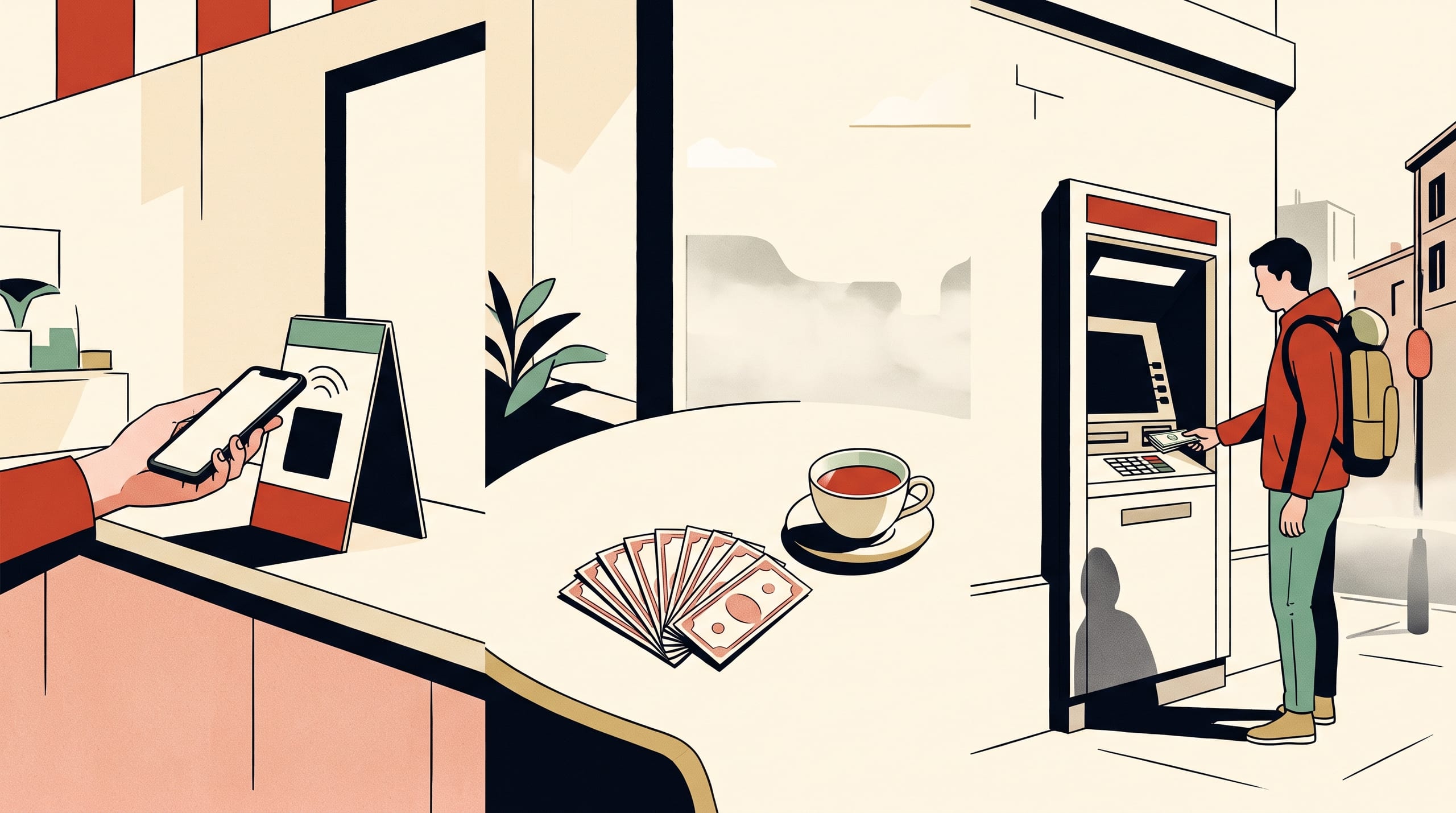
The Golden Rule of Cash in China: Break Your 100 RMB Notes
The People's Bank of China has strictly cracked down on merchants refusing RMB cash, so stores, taxis, and ticket counters are legally required to accept banknotes. The catch is practical, not legal: because almost everyone pays by phone, taxi drivers and small noodle shops rarely keep change for a 100 RMB bill in their till.
Where to get cash: Withdraw 500 to 1,000 RMB on arrival from a major Chinese bank ATM. Bank of China, ICBC, China Construction Bank, and Agricultural Bank of China all reliably accept foreign Visa, Mastercard, Plus, Cirrus, and UnionPay debit cards. Most ATMs cap single withdrawals around 2,500 to 3,000 RMB.
How to get small bills: Take your crisp 100 RMB notes to a hotel front desk, a subway customer-service window, or a 7-Eleven / FamilyMart convenience store and buy a bottle of water to break them into 5, 10, 20, and 50 RMB notes.
How to pay exact fare in a taxi: If you only have a 100 RMB bill for a 28 RMB taxi ride and the driver has no change, ask them to accept the 100 RMB note and transfer the 72 RMB difference back to you, or keep 10 and 20 RMB notes in your wallet for cabs.
Where You Can Tap or Swipe a Physical Foreign Card
Outside of Alipay and WeChat Pay, direct acceptance of physical Visa and Mastercard cards is limited, though major tourist hubs have expanded contactless support in recent years.
Direct tap-to-pay on subways: The Beijing Subway (across its urban lines and airport express links) and Chengdu Metro now let you tap a contactless foreign Visa or Mastercard directly at the turnstile gate without using an app, and Shanghai has rolled out expanded foreign card support on maglev and transit corridors.
International hotels and high-end dining: Four- and five-star hotels, international retail chains, and flagship department stores in Tier 1 cities have POS terminals that accept foreign Visa, Mastercard, and Amex directly. They are the best place to pay big accommodation bills without triggering Alipay's 3% fee over 200 RMB.
High-speed rail tickets: Station ticket counters accept cash and often major foreign cards, though booking online in advance is far easier; see our guide to China high-speed rail for first-timers for how ticketing works.
Backup Plan: What to Do If Everything Fails
If both Alipay and WeChat Pay decline your payments in China, your immediate backup plan is to switch to your second linked card, approve any pending fraud text from your home bank, withdraw cash at a major Chinese bank ATM, or ask your hotel concierge to pay via their local account in exchange for cash.
Even well-prepared travelers occasionally hit a declined payment screen. This usually happens when a home bank's fraud system gets spooked by multiple small Chinese merchant charges in a row, or when a merchant's QR code is actually a personal transfer code and not a registered business code.
Check whether the QR code is a personal code: Very small street stalls sometimes print out a personal WeChat or Alipay "Receive Money" QR code instead of a commercial merchant code. Because foreign cards cannot fund peer-to-peer transfers, your scan will fail. Hand the vendor small cash instead, or ask if they have a commercial merchant code (shangjia ma).
Call or message your bank to clear 3D Secure blocks: If a transaction fails above 100 or 200 RMB, check your SMS inbox or banking app for a fraud verification prompt. Approving the prompt usually restores card function immediately.
Switch between Alipay and WeChat Pay: Keep both apps ready; if Alipay's payment gateway times out with your card issuer, the exact same card linked inside WeChat Pay will often go right through.
Use the hotel concierge workaround: If you need to book a domestic attraction ticket or DiDi ride that refuses your card, ask your hotel front desk to make the payment from their local account and hand them the exact amount in RMB cash.
Consider the UnionPay TourCard or NihaoPay only as a last resort: Bank of Shanghai's TourCard mini-program inside Alipay lets foreigners load a prepaid virtual UnionPay card, but it charges a hefty 5% top-up fee, making it worth using only if standard card linking fails completely.

Alipay Discounts and Vouchers for Foreign Travelers
International users registered on Alipay with an overseas phone number and foreign bank card can claim built-in tourist voucher packs, spontaneous random instant discounts at checkout, and special exchange-rate coupons directly from the app's home banner and payment confirmation screens.
Because Alipay and international card networks actively compete for inbound tourist spending, paying via the app can sometimes cost less than the sticker price on the menu. You do not need a Chinese phone number to claim the main international user perks:
Inbound tourist voucher packs: When your Alipay app is set to an international region and English language, look for the promotional banner on the home screen offering overseas user coupon packs, often totaling up to 200 RMB in small tiered discounts (such as 5 RMB off 20 RMB, or discounts on metro rides and airport convenience stores).
Card-network binding promotions: Visa, Mastercard, and UnionPay periodically run instant-discount campaigns inside Alipay and WeChat Pay where linking a qualifying card takes a few yuan off your first several purchases or waives the 3% fee during a promotional window.
Alipay+ Membership汇率 (exchange-rate) tiers: Every payment you make in Alipay earns points toward higher membership tiers (Silver, Gold, Diamond), which slightly improve the in-app foreign exchange rate offered on transactions.
Once your apps are verified and you have a few small banknotes tucked into your bag, paying in China quickly fades into the background of your trip. If you are ready to map out where you are actually going and what each stop will cost, you can pull your route and line-item city expenses together in the China trip planner, and download a full offline PDF of your itinerary and budget before you head to the airport.