China High-Speed Rail for First-Timers: Tickets, Stations, Seats, and How It Actually Works
Everything a first-time traveler needs to know before boarding a Chinese bullet train—from comparing 12306, Trip.com, and Ctrip fees to navigating passport gates, choosing seat classes, and deciding when to fly instead.
Standing outside a Chinese high-speed rail station for the first time can make even seasoned rail travelers second-guess themselves. Instead of walking straight onto a platform two minutes before departure like you might in Europe or Japan, you are looking at a terminal the size of an international airport, complete with X-ray security lanes, passport-scanning gates, and numbered waiting lounges.
Once you understand the rhythm of the system, however, China Railway High-speed (CRH) is one of the easiest, smoothest, and most punctual ways to move across a continent-sized country. Whether you are trying to figure out why ticket prices look different across apps, wondering if a "hard seat" will ruin your spine, or deciding between a seven-hour train and a flight, this guide walks you through how high-speed rail in China actually works from booking to boarding.
Where to Book: 12306 vs. Trip.com vs. Ctrip
First-time travelers to China should book high-speed train tickets either through the official Railway 12306 app for zero booking markups or through Trip.com for a smoother English interface and advance reservation hold features, while Ctrip is only practical if you read Chinese and already have a Chinese payment method configured.
Before comparing apps, there is one foundational rule to know: paper tickets for domestic high-speed trains are largely a thing of the past. Your passport is your ticket. Regardless of which app or website you use to buy your seat, your reservation is written directly into China Railway's central system under your passport number.
Platform | Booking Service Fee | Foreign Card Fee | Best For |
|---|---|---|---|
Railway 12306 (Official) | None (0 CNY) | None via Alipay/WeChat under 200 CNY; 3% over 200 CNY | Avoiding agency markups and changing tickets directly |
Trip.com | Typically ~15–40 CNY ($2–$6 USD) per ticket | None (built into currency checkout) | Pre-booking before the 15-day window and easy English support |
Ctrip (携程) | None on base fare (watch for bundled add-ons) | Requires Chinese payment or Alipay/WeChat setup | Chinese speakers who can uncheck default VIP acceleration bundles |
Station Ticket Counter | None at station; 5 CNY at neighborhood agencies | Cash, Alipay, WeChat, or major cards at main hubs | Last-minute changes when an app rejects your passport format |
Railway 12306 (The Official App)
Railway 12306 is China Railway's official ticketing platform, selling every high-speed and conventional train seat at exact face value with zero booking commission, direct seat selection for upper-tier classes, and access to the official waitlist system when popular routes sell out.
In recent years, 12306 has added an English mode and simplified identity verification so foreign travelers can register and scan their passports before leaving home. While the English version works well for straightforward point-to-point bookings, switching the app to its Chinese interface (or using the 12306 mini-program inside Alipay) gives you extra features like choosing a window or aisle seat and joining the official waitlist (houbu) when a train is full. For a complete walkthrough of setting up your account and passing identity verification, read our step-by-step guide on how to buy high-speed train tickets in China as a foreigner.
Why Is Trip.com More Expensive Than Ctrip?
Trip.com costs more than its Chinese sister app Ctrip because Trip.com charges an explicit per-ticket booking fee and currency conversion spread for international travelers, whereas Ctrip sells tickets at face value in CNY inside China while monetizing through optional paid priority-booking bundles.
Both apps are owned by the same parent company (Trip.com Group), which often confuses travelers comparing screenshots on Reddit. On Trip.com, you pay a transparent service fee per ticket in exchange for 24/7 English customer service, straightforward foreign credit card checkout, and a pre-order feature that lets you queue up your ticket purchase months in advance. On Ctrip (the Chinese-only domestic app), the base ticket price matches 12306, but the checkout screen frequently pre-selects "VIP grab-ticket acceleration packages" or accidental insurance worth 20 to 50 CNY. If you can read Chinese and uncheck those boxes, Ctrip is cheaper; if you cannot, you can easily end up paying the same markup without realizing it.
Booking Window, Waitlists, and Sell-Out Risk
China Railway opens high-speed train ticket sales exactly 15 days before departure (including the departure date itself), with release times staggered through the day by departure station. There is no single midnight release.
For example, if you are traveling on the 15th of the month, tickets go on sale on the 1st. A station like Beijing West might release its batch in the morning, while Shanghai Hongqiao releases tickets in the afternoon. If you book through an agency like Trip.com two months early, you do not yet hold a confirmed seat. The agency stores your request and tries to buy the ticket for you the moment the 15-day window opens on 12306.
Should you worry about trains selling out? For most of the year, trunk corridors like the Beijing to Shanghai train (around 50 departures a day) or short commuter hops like the Suzhou to Shanghai train have so much capacity that booking 3 to 7 days ahead is plenty. However, tickets can vanish within minutes under three specific conditions:
Major domestic holidays: Lunar New Year (Chunyun), Labor Day week (early May), and National Day Golden Week (October 1 to 7), when hundreds of millions of people travel at once.
Bottleneck tourist routes: Routes with only a handful of daily direct trains, such as Chengdu to Jiuzhaigou (Huanglongjiuzhai Station) or afternoon trains out of Zhangjiajie.
Friday afternoons and Sunday evenings: Regional lines under three hours fill up quickly with weekend commuters.
If you are stringing together several stops in Chinerary, the planner generates ticket-release date reminders for every high-speed rail leg in your itinerary. They show the exact day 12306 opens ticket sales (15 days before departure) and note when an agency like Trip.com might unofficially accept the booking earlier. You can download them as a .ics calendar file (free for every account until January 1, 2028).
If you need to cancel or change a booked ticket, China Railway allows one free date or train change per ticket (subject to any fare difference), and applies a tiered refund schedule based on how far ahead of departure you cancel:
Cancellation Time Before Departure | China Railway Refund Fee |
|---|---|
8 days (192 hours) or more | 0% (Full refund of the official ticket fare) |
48 hours to less than 8 days | 5% of ticket fare |
24 hours to less than 48 hours | 10% of ticket fare |
Less than 24 hours before departure | 20% of ticket fare |
Stations, Passport Gates, and How Early to Arrive
First-time foreign passengers should arrive at a Chinese high-speed rail station 45 to 60 minutes before departure to clear entrance passport checks, luggage X-ray scanners, and the walk to their specific boarding gate, which typically opens 15 minutes before the train leaves and closes 3 to 5 minutes prior.
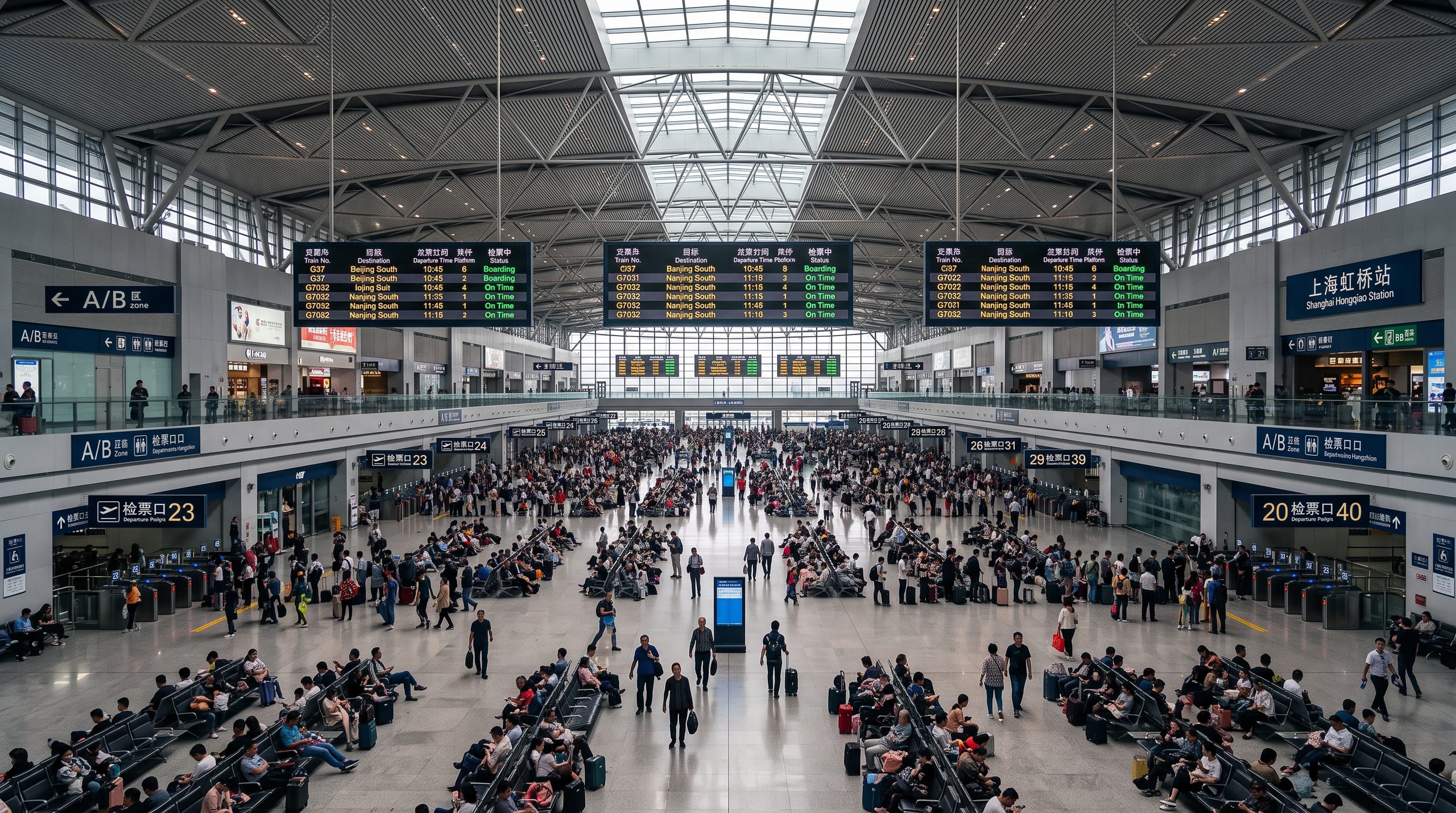
Chinese railway stations operate on a closed-loop departure model similar to airports. You do not walk onto the platform to wait for your train; instead, you wait in a massive upper-level departure hall lined with dozens of numbered ticket gates (Jianpiaokou, 检票口) and only descend to the platform when your specific train begins boarding.
Follow this four-step sequence at every station:
Confirm which station matches your ticket: Major cities have four or five railway stations, often an hour apart by metro. "Beijing" (Beijing Railway Station), "Beijing West" (Beijingxi), and "Beijing South" (Beijingnan) are completely different buildings across town. Always double-check the suffix (North/Bei, South/Nan, East/Dong, West/Xi) before getting in a taxi.
Pass the outer entrance and security check: At the main entrance doors, place your passport face-down on the automated scanner at the gate, or use the staffed lane (Rengong Tongdao, 人工通道) on the far end if the scanner does not read your passport chip. Immediately after the gate, put all bags through the X-ray belt and walk through the metal detector.
Find your boarding gate (Jianpiaokou): Look up at the large red or blue LED departure boards, find your train number (for example,
G12orD2204), and check the gate number on the far right column (often labeled with an A or B, such as12A). Your gate number also appears in the 12306 or Trip.com app on the day of travel.Scan your passport at the platform gate: About 15 minutes before departure, the gate screen turns green and crowds line up. Walk to the automated e-gate with a passport icon or the staffed manual lane on the side, scan your passport, and follow the signs down the escalator to the car number (Chexiang, 车厢) printed on the colored floor decals along the platform edge.
Seat Classes Explained (And How Bad Are Hard Seats?)
Modern high-speed bullet trains (G, D, and C series) do not have "hard seats" at all; their most affordable standard cabin is Second Class, which offers padded, reclining airline-style seats with generous legroom and power outlets, while actual Hard Seats only exist on older, slower conventional trains (K, T, and Z series).
One of the most frequent worries among first-timers comes from mixing up China's two distinct rail networks. If your train number starts with G (Gaotie, up to 350 km/h), D (Dongche, up to 250 km/h), or C (Chengji, short intercity), you are riding a modern white-or-silver bullet train. Every seat on board is padded, reclines, and has fold-down tray tables.
Seat Class | Row Layout | Comfort & Onboard Features | Best For |
|---|---|---|---|
Second Class (二等座) | 3 + 2 (five across) | Padded reclining seat, generous legroom, fold-down tray, shared power sockets | Almost every trip under 5 hours; best value for money |
First Class (一等座) | 2 + 2 (four across) | Wider seat, extra knee room, footrest, pillow, quieter cabin | Trips of 4–8 hours when Second Class is only 30–50% cheaper |
Business / Premier Class (商务座) | 2 + 1 or 1 + 1 pods | Lie-flat leather pods, station VIP lounge access, complimentary hot meal and snacks | Long-haul journeys when you want airline business-class comfort |
Hard Seat (硬座 — K/T/Z trains only) | 3 + 2 bench rows | Upright lightly padded benches that do not recline, crowded aisles with standing ticket holders | Short budget daytime hops on routes without high-speed service |
So how bad is an actual Hard Seat on a green K, T, or Z conventional train? Despite the name, the seat has a thin layer of upholstery and is not a wooden bench. For a two- or three-hour daytime ride, it is perfectly fine and costs very little. For anything longer, especially overnight, a Hard Seat is exhausting: the backrests sit nearly at a 90-degree angle, overhead racks fill up to bursting, and railways sell "standing tickets" inside Hard Seat carriages, meaning the aisles are often packed with passengers sitting on folding stools or luggage. If you ever take an overnight conventional train, always book a Soft Sleeper (4-berth lockable compartment) or Hard Sleeper (6-berth open bay) instead.
Bullet Train vs. Flight: When to Ride and When to Fly
Choose a high-speed train over a domestic flight in China whenever the rail journey is under five hours. Between five and seven hours the train is nearly always still the better choice once airport transfers and weather delays are factored in. Switch to flying or an overnight high-speed sleeper once daytime train travel exceeds seven to eight hours.
On paper, a two-hour flight sounds much faster than a five-hour train ride. In practice, Chinese airspace is heavily congested, summer thunderstorms routinely delay afternoon flights across eastern and southern China, and major airports sit 40 to 60 minutes outside the city center. High-speed trains depart on the minute over 95% of the time, let you keep full 5G data reception the entire way, and drop you directly onto the urban metro network.
Route Example | Fastest HSR Time | Flight Door-to-Door Time | Better Choice |
|---|---|---|---|
Suzhou to Shanghai | ~15–25 mins | No flights (drive/rail only) | High-Speed Train (runs every few minutes) |
Beijing to Shanghai | ~4h 20m – 4h 35m | ~5h 15m (incl. airport transfers & 2h15m flight) | High-Speed Train (faster center-to-center and far more reliable) |
Shanghai to Zhangjiajie | ~7h 15m – 9h 15m | ~5h 30m (direct evening flights, ~2h 40m air time) | Toss-up: Train for daytime scenery & reliability; Evening flight to save a daytime half-day |
Shanghai to Guangzhou | ~6h 15m – 8h 00m | ~5h 30m (frequent flights, ~2h 30m air time) | Fly during the day, or take the overnight D-series high-speed sleeper train |
Take the classic Reddit debate: Shanghai to Zhangjiajie by high-speed train or flight? The fastest direct G-train leaves Shanghai Hongqiao in the morning or early afternoon and reaches Zhangjiajie West in about 7 hours and 15 minutes, costing roughly 550 to 700 CNY in Second Class. Direct flights take about 2 hours and 40 minutes in the air, which works out to around 5 to 6 hours door-to-door. If you prefer leaving after dinner so you wake up at the national park the next morning, a direct evening flight wins; if you have a daytime travel day or want to avoid mountain weather flight cancellations, the 7-hour bullet train is a comfortable, stress-free ride. Even on longer routes like the Shanghai to Guangzhou train, many travelers take an evening D-series high-speed sleeper train to save a hotel night and arrive downtown at breakfast time.
To compare exact rail times against flying for your own stops, you can check direct schedules and fares on our train connection checker, or open the Chinerary route planner, where a searchable panel shows every city directly reachable by train from any stop on your route, with real travel times, fares, and daily train counts, and non-reachable cities dimmed on the map (free for every account until January 1, 2028).
Luggage Rules, Prohibited Items, and Onboard Food
Adult passengers on China high-speed trains can bring up to 20 kg (44 lbs) of luggage with a maximum linear dimension (length + width + height) of 130 cm per bag on G/D/C trains, though weight is rarely checked at the station while X-ray scanners strictly enforce bans on knives, large aerosols, and oversized power banks.
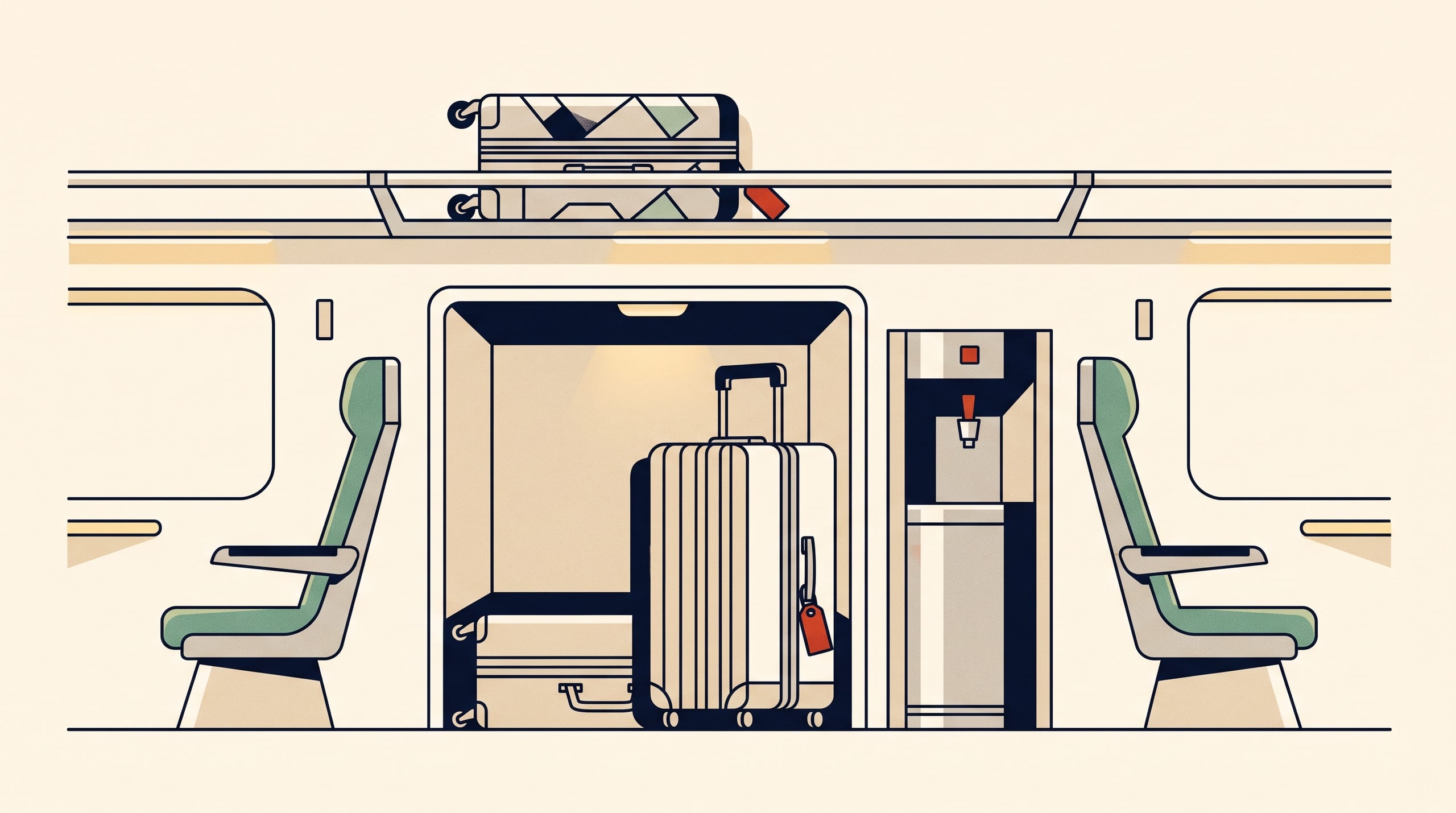
In real life, nobody stands at the gate with a luggage scale or tape measure. If you can lift your bags through the X-ray machine and carry them onto the train yourself, a standard 24-inch or even 28-inch spinner suitcase will get on board without issue. Overhead racks above the seats easily fit 20- to 24-inch bags, while larger 26- to 28-inch suitcases fit in the luggage closets located at the ends of each carriage (between the seat cabin and the vestibule doors). Board promptly when the gate opens if you have a large suitcase, as those end-of-car racks fill up first.
What is strictly policed is what goes through the X-ray scanner at the station entrance. Security officers will ask you to open your bag if they spot any of these restricted items:
Pressurized aerosols over 150 ml: Deodorant sprays, hairsprays, sunscreen sprays, and dry shampoo in pressurized cans larger than 150 ml are confiscated on the spot. Bring roll-on deodorant and lotion sunscreen instead.
Knives and sharp tools: Pocket knives, Swiss Army knives, fruit knives, and multi-tools with blades of any locking or standard length are prohibited in carry-on luggage on trains, even inside checked-size suitcases.
Power banks over 100Wh (~27,000mAh): Every portable charger must have a legible factory capacity label under 100Wh. Unmarked or oversized power banks are held at security.
Flammable liquids and high-proof alcohol: Nail polish remover, lighter fluid, and unsealed bottles of alcohol are banned (sealed retail boxes of Chinese baijiu between 24% and 70% ABV have specific volume limits).
Food, Hot Water, and Dining on Board
Unlike airlines, Chinese trains let you bring virtually any food and sealed drinks through security. Just pull your water bottle out of your backpack at the X-ray belt so the officer can set it on the liquid scanner for two seconds. Every high-speed train has a dining car (usually near the middle of the train, around Car 5 or Car 8) selling hot boxed meals for roughly 40 to 65 CNY, along with coffee, fruit, and snacks. On many G-trains, you can also scan the QR code on the arm of your seat using WeChat or Alipay to order KFC, Starbucks, or local restaurant takeout to be delivered directly to your seat at the next major station stop. Free boiling water taps are located at the end of every carriage for tea and instant noodles.
6 Common First-Timer Mistakes to Avoid
Most high-speed rail hiccups in China happen before you step onto the train: going to the wrong city station, typing passport names in the wrong order, or waiting on the platform edge at the wrong car number during a two-minute intermediate stop.
Going to the wrong station in the right city: Always verify the full station name on your reservation before booking a Didi or boarding the metro. Going to Shanghai Station instead of Shanghai Hongqiao Station when you have 40 minutes left means missing your train.
Swapping first and last names during booking: China Railway prints and matches names in the exact order shown on the machine-readable zone of your passport:
LASTNAME FIRSTNAME MIDDLENAMEwith no spaces or hyphens if required by the app prompt. If the automated gate rejects your passport scan because of a space or middle name, walk straight to the staffed manual lane at the end of the row. The attendant can verify your passport number manually in seconds.Boarding a 16-car train at the wrong end of the platform: A 16-car Fuxing train is over 400 meters long. On intermediate stops, the train frequently halts for only 2 to 3 minutes. Check the colored LED signs overhead or the colored numbers painted on the platform edge so you are standing directly at your Car (Chexiang) number before the train pulls in.
Packing a fruit knife or large aerosol spray: What flies in checked airline baggage will get flagged at a train station because you carry all your bags onto the train yourself. Leave pocket knives and big spray cans at home.
Throwing away your reimbursement receipt thinking it is a ticket: If you print a blue paper slip at a station kiosk, read it carefully: it says "Reimbursement Receipt Only" (报销凭证), which means it is not a boarding pass. You still scan your passport to open the gates.
Waiting until you reach the station to buy tickets on a Friday or holiday: Many major stations have scaled back ticket office windows because almost everyone books on their phone. Secure your seats on 12306 or Trip.com days ahead so you can walk straight through security.